How Live Football Odds Respond to What Happens on the Pitch
Live football odds are not static numbers. From the first whistle to the final minute of added time, they shift continuously in response to what is unfolding on the pitch, how the broader market is reacting and how much time remains. For anyone following a game with an interest in in-play betting, understanding why prices move — and what each movement signals — is far more valuable than simply watching odds change on a screen.
Bookmakers use automated pricing models and human traders to update odds in real time, recalculating probabilities based on the current score, the balance of play and a range of statistical inputs. A single moment can reshape available markets entirely. Recognising the causes behind price movement gives bettors a more grounded framework for decision-making — shifting focus to the match itself, which is exactly where attention belongs.
The Match Events That Trigger the Biggest Odds Movements
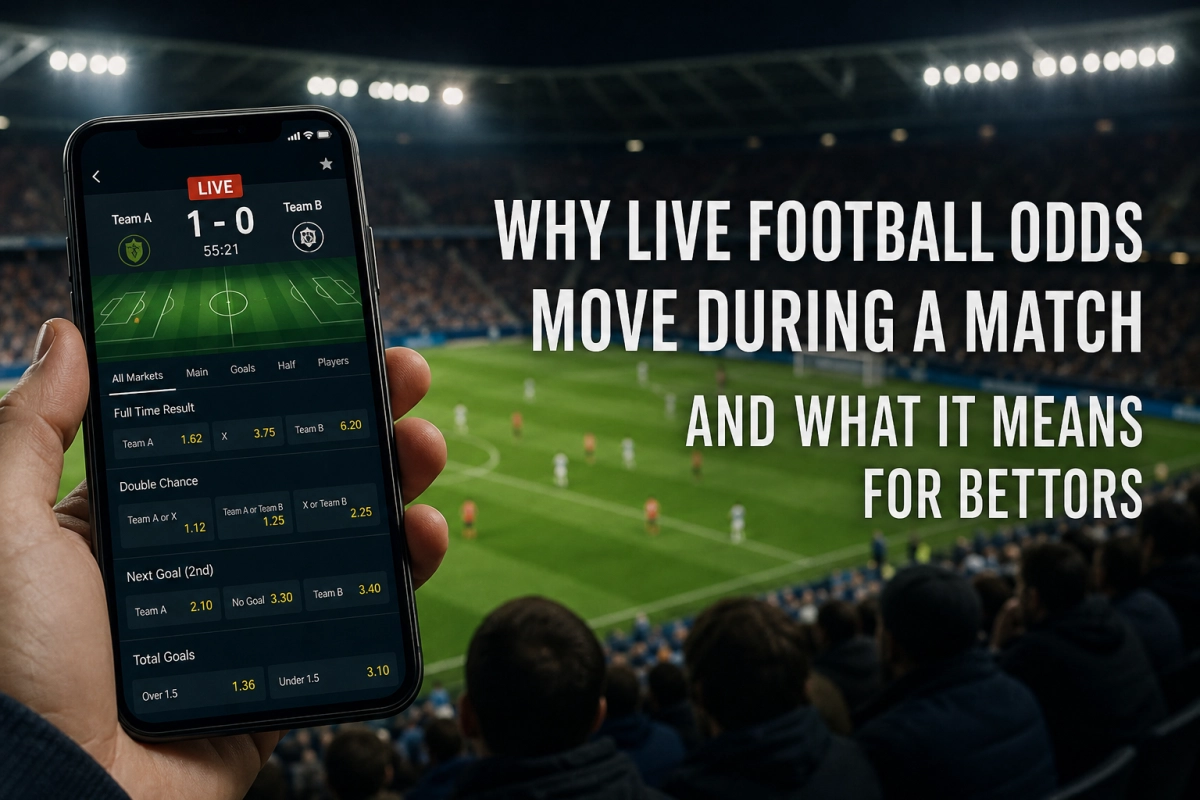
Certain events produce immediate and significant changes across live markets. A goal is the most obvious example. The scoring team shortens in price, the opposition drifts, and connected markets — next goal odds, total goals lines, both teams to score — all adjust within seconds.
Red cards carry comparable impact. Losing a player alters defensive shape, limits attacking options and introduces a sustained imbalance for the remainder of the game. Bookmakers push the ten-man team’s odds out considerably, particularly in match result and Asian handicap markets.
Injuries to key players can quietly move prices in ways less attentive bettors overlook. A striker forced off when the bench is depleted often signals a structural shift in attacking threat — something the odds begin reflecting before the tactical consequences become fully visible.
Substitutions and Tactical Changes
Substitutions frequently carry clear tactical intent. A manager introducing an additional forward in the 65th minute while trailing signals intent to push higher and accept more defensive risk. That compresses next goal odds for the chasing team and can shorten over/under markets as the game opens up.
Defensive substitutions tell the opposite story. Replacing an attacker with a holding midfielder to protect a lead typically slows the tempo. Under markets may shorten accordingly, reflecting the reduced probability of further scoring.
Possession, Shots and Dangerous Attacks
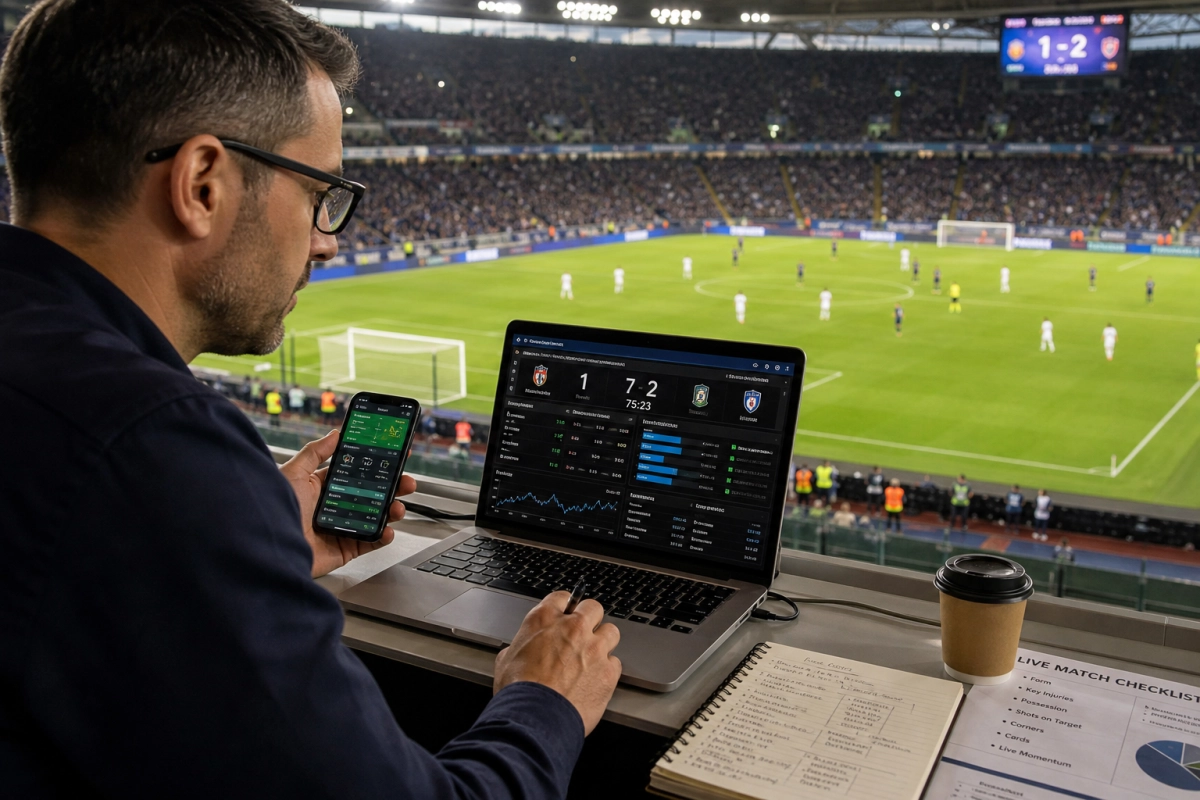
Beyond discrete events, live odds also respond to the broader rhythm of a match. Sustained pressure — measured through shot counts, shots on target and dangerous attacks — gradually influences pricing even without a goal. A team creating repeated chances will often see its odds compress slightly, reflecting an increased probability of a breakthrough based on the volume and quality of opportunities being generated.
This is where watching the match carefully, rather than relying on pre-match assessments or team reputation, becomes genuinely useful. Odds shift because probabilities shift, and probabilities shift because the match is telling its own story.
How Time and Scoreline Shape the Scale of Every Movement
The same goal scored in the 20th minute and the 80th minute produces very different odds reactions. Time remaining is one of the most powerful variables in live pricing. Early in a match, a team going one goal down retains plenty of time to recover and the market prices that accordingly. As minutes drain away, the mathematical space for recovery contracts sharply — and the odds reflect that contraction almost ruthlessly.
This creates a particular dynamic in closing stages. Odds in the final fifteen minutes can move in dramatic increments from relatively minor events. The sensitivity of the pricing model increases as the clock runs down, meaning the informational value embedded in each movement also increases. A price that shifts noticeably in the 85th minute carries more signal than the same-sized shift in the 30th.
Reading the Difference Between Reactive and Anticipatory Movements
Not every odds movement responds to something that has already happened. Some shifts are anticipatory — the market pricing in what it expects based on current conditions. Recognising this distinction is one of the more nuanced skills a live bettor can develop.
Anticipatory movements tend to appear when:
- A team has been awarded a penalty but the kick has not yet been taken
- A player is receiving extended treatment and appears likely to be substituted
- A referee is reviewing a decision via VAR, with a potential red card or penalty pending
- A goalkeeper has been visibly flagged as struggling with an injury mid-play
In each situation, the market moves toward the most probable outcome before it is confirmed. Bettors watching closely will see the shift beginning in real time, while those relying purely on a data feed may only register the event after the fact. The window is narrow, but for those able to read it accurately, it represents one of the more legitimate edges available in live betting.
Reactive movements, by contrast, are largely efficient. The moment a goal is confirmed, automated systems reprice almost simultaneously. Attempting to beat a reactive movement on popular games is rarely productive. The value lies not in speed but in interpretation — identifying whether the market has overreacted or underreacted to the event in question.
When the Market Overreacts and What That Suggests
Live pricing models are built for speed, and speed carries a trade-off. In the immediate aftermath of a significant event, odds can overshoot the genuine probability shift. These overreactions are most common after goals scored against the run of play, red cards in unusual circumstances and late equalisers that momentarily distort the emotional temperature of a match.
A red card offers a useful illustration. When a player is sent off, the ten-man team’s odds lengthen as standard — but the degree to which that is justified depends heavily on context. A defensive midfielder dismissed in the 85th minute of a match where his team holds a two-goal lead is a very different event from a centre-back sent off in the 30th minute of a closely contested game. Both trigger automatic repricing, but if the market responds with equal force to both scenarios, the former may present a mild distortion worth examining.
Similarly, goals from set pieces or long-range efforts against a team that has otherwise dominated can prompt sharper movement than the underlying match picture supports. If the balance of play clearly favours the now-trailing side, the compressed odds on the team in front may not reflect where the match is actually heading. Watching the game — and trusting what it reveals — remains the most reliable way to assess whether a price has settled at a reasonable level or simply a reactive one.
Using Price Movements as a Reading of the Match Itself
The most practical shift a live bettor can make is to stop treating odds as the primary source of information and start treating them as a secondary one. The match is the primary source. The odds are the market’s interpretation of it — useful, often accurate, but never infallible and always subject to the speed constraints governing automated pricing.
When a price moves and you already know why, you are watching confirmation. When a price moves and the reason is not immediately obvious, that gap is worth investigating. It may indicate the data feed has picked up something you missed, or that the market is momentarily mispricing based on incomplete context. Both are informative. Neither should be acted on blindly.
Developing a sense of which movements carry genuine signal and which are noise requires time spent watching live football with the odds visible alongside the match. Over time, patterns emerge — goals against the run of play produce sharper reactive movements than goals that feel inevitable; red cards in the closing stages of lopsided matches move odds more dramatically than their practical impact often justifies. These patterns are not exploitable in any mechanical sense, but they sharpen judgment considerably.
The Role of Composure in Fast-Moving Markets
One of the more consistent errors made by live bettors is conflating the speed of a price movement with the urgency of a decision. A sharply moving line is not necessarily an invitation to act — it is an invitation to think. The window for genuinely good in-play decisions is often slightly later than instinct suggests, once the market has stabilised and the match has had a moment to reveal whether the triggering event was as decisive as it initially appeared.
Waiting for that settling point, rather than chasing the movement as it happens, tends to produce cleaner decisions. The odds may not be as extreme as in the immediate aftermath, but they will reflect a more accurate picture of what the match is actually showing — and that clarity is worth more than the marginal price improvement that comes from acting in the first few seconds of a market shift.
Reading Live Odds With the Confidence of Someone Watching the Game
Live football odds are, at their core, a running probability estimate generated under pressure and at speed. They are accurate enough to be useful, efficient enough to be difficult to beat consistently and imperfect enough to reward those who watch closely and think carefully.
The events that move them most — goals, red cards, substitutions, sustained pressure, injuries and VAR interventions — are all visible to anyone paying attention. The skill lies not in accessing special information, but in interpreting familiar information more clearly than the automated models that set the initial price. When the scoreline does not reflect the match, when a sending-off matters less than the standard reprice suggests, or when a substitution signals a tactical shift the odds have not yet absorbed, the market has left a small but legible gap between price and reality.
Those gaps close quickly. But for bettors who have learned to read a live match as attentively as they read the odds running alongside it, they close just slowly enough to matter.