
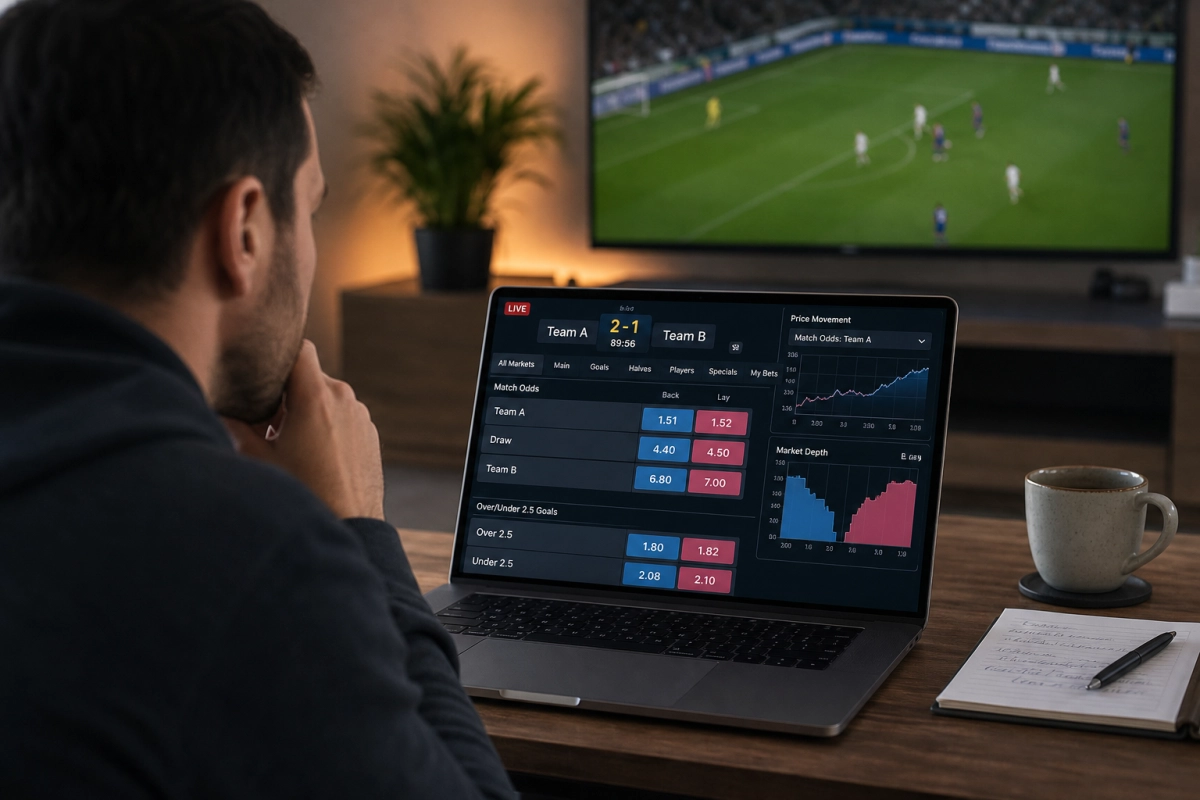
Why Live Football Odds Move Differently From Pre-Match Prices
Anyone who has watched a match unfold on a betting platform will have noticed how rapidly numbers shift. A team wins a corner, the odds nudge. A goalkeeper receives a red card, and the market looks entirely different. This is the defining characteristic of live football odds — they are dynamic calculations that respond to events second by second, not static prices set hours in advance.
Understanding why those movements occur gives bettors a far clearer framework for making decisions during a match rather than reacting impulsively to a flashing number. This article explains the mechanics behind in-play odds, the match factors that trigger the most significant shifts, and how to read those changes with greater confidence.
How Bookmakers Calculate In-Play Odds
Before kick-off, bookmakers use historical data, team form, lineup information, expected goals models and market sentiment to set pre-match prices. Once the whistle blows, that foundation is continuously updated by automated algorithms and, in some cases, human traders monitoring the game directly.
The core principle is probability. Every set of live odds reflects the bookmaker’s estimation of how likely a given outcome is at that specific moment. If a team begins dominating possession and creating clear chances, the algorithm recalibrates their win probability upward — their odds shorten, and the opposing team’s odds lengthen. Bookmakers also build a margin into every market, ensuring combined implied probability exceeds 100%. That margin does not disappear during live play; it adjusts alongside the odds.
Algorithms and Market Suspension
Most sportsbooks rely on automated pricing engines that process real-time data feeds — tracking shots, possession, set pieces, fouls and more — adjusting odds within fractions of a second. This is why markets briefly suspend around moments of high uncertainty, such as a penalty award or a goal under VAR review. The bookmaker pauses until the outcome is confirmed, then reopens with revised prices. Different bookmakers may price the same moment slightly differently depending on their data providers, risk models and the volume of money they are managing — which is why some bettors compare prices across platforms before placing an in-play wager.
Match Events That Trigger the Sharpest Movements
Not every on-pitch event produces a meaningful shift. A misplaced pass in midfield will not move the market. But certain moments carry enough statistical weight to prompt an immediate and dramatic recalculation.
- Goals: The single biggest driver of in-play movement. The scoreline changes, remaining time shortens, and the probability distribution shifts substantially. A slight underdog can become a strong favourite within seconds of scoring.
- Red cards: Reducing a team to ten men has a measurable impact on their ability to control a match. Algorithms factor in numerical disadvantage quickly, and odds can swing dramatically even without a goal.
- Penalties awarded: A penalty represents roughly a 75–80% scoring opportunity, making it a significant probability event. Markets typically suspend immediately on the award.
- Injuries to key players: If a team’s primary striker or goalkeeper is forced off, live odds respond — though the degree depends on the replacement and how early in the game it occurs.
- Tactical substitutions: A defensive substitution when a team is winning signals an intention to protect the scoreline. Models interpret this as a behavioural signal and may shorten the odds on a draw or opposition goal accordingly.
How Time Remaining Reshapes Every Live Probability
One element that distinguishes live football odds from almost every other market is the way time functions as a compressor. As minutes pass, the range of realistic outcomes narrows and the probability distribution tightens around the current scoreline. A team trailing by one goal in the fifth minute has a very different statistical outlook than the same team in the same position with eight minutes left.
Bookmakers encode this directly into their algorithms. The closer a match gets to the final whistle, the more extreme the odds become at both ends. A team leading comfortably in the 80th minute is priced at very short odds not because anything dramatic has happened, but because time has removed most scenarios in which they could fail to hold on.
This is where many casual in-play bettors make avoidable errors. They see a short price on the leading team late in a match and assume low value, without recognising the price is mathematically justified. Equally, they overestimate the chance of a comeback simply because a trailing team is playing with urgency — urgency does not always translate into statistical probability of recovery, particularly inside the final ten minutes.
The Momentum Trap
A common temptation is to chase what appears to be momentum. A team stringing together several attacks feels dangerous, and the instinct is to back them before the bookmaker catches up. In reality, modern algorithms respond far faster than most bettors anticipate. By the time a punter has identified a spell of pressure and decided to act, the odds have typically already adjusted.
What momentum-based movements usually reflect is a genuine shift in the underlying probability model, not a pricing delay. If a team consistently generates high-quality chances, the expected goals data registers a meaningful change in match dynamics. That said, there are moments where the market reacts to the surface appearance of pressure rather than its statistical substance — a string of long-range efforts easily saved can look threatening without generating real scoring probability. Experienced bettors focus on shot quality and positioning rather than volume alone.
Reading Odds Movements as Information, Not Instruction
Perhaps the most practically useful skill in live betting is treating odds movements as data points rather than directives. When a price shortens suddenly, the immediate question should not be whether to follow it, but what the movement is telling you about how the market has interpreted the last few minutes of play.
There are broadly two reasons a live price moves sharply. The first is a genuine change in match probability driven by an in-game event — a goal, a dismissal, an injury. These are usually clean and easy to interpret. The second is heavy money entering the market on one side, forcing the bookmaker to adjust prices to balance exposure regardless of what is happening on the pitch. This second type can occasionally reveal what sharp bettors are thinking.
- Sudden shortening without an obvious event: May indicate sharp money entering based on information not immediately visible — a looming substitution, a tactical change, or a model-driven assessment of match trajectory.
- Odds drifting on a team despite them attacking: Could reflect heavy backing on the opposing side, or a model recalibrating around shot quality and finding it less threatening than it appears.
- Market suspension without a visible incident: Sometimes signals the data feed has detected something — a disallowed goal or VAR check — before the broadcast has caught up.
None of these signals are infallible, and chasing every unexplained movement leads to poor decisions. But developing the habit of asking what a price movement means, rather than simply whether to follow it, is what separates reactive in-play betting from something more considered and sustainable.
Turning Market Literacy Into a More Disciplined In-Play Approach
Live football betting is an exercise in probability reading under time pressure. The bettors who navigate it most effectively are rarely those with the sharpest instincts or fastest reactions. They are the ones who understand what the numbers in front of them actually represent — and what they do not.
Before placing any in-play wager, it is worth asking three questions: what has actually changed in the match to justify this price, how much time remains for that change to have a meaningful effect on the outcome, and is this movement driven by the game itself or by money flowing through the market for reasons not visible on screen? None of these questions will guarantee a correct decision. But they create a structure that pulls you away from impulse and toward something more deliberate.
Live odds are, in the end, a compressed and continuously updated story of a football match told in numbers. Learning to read that story — to see the logic behind a drifting price or a sudden suspension, to understand why a five-minute spell of pressure does not always move the needle as much as it feels like it should — is what transforms in-play betting from a reaction game into something closer to a skill. That skill will not remove the inherent uncertainty of football. But it will ensure that when you place a live wager, you are doing so with your eyes open to what the market is actually saying, rather than what you hope it might mean.