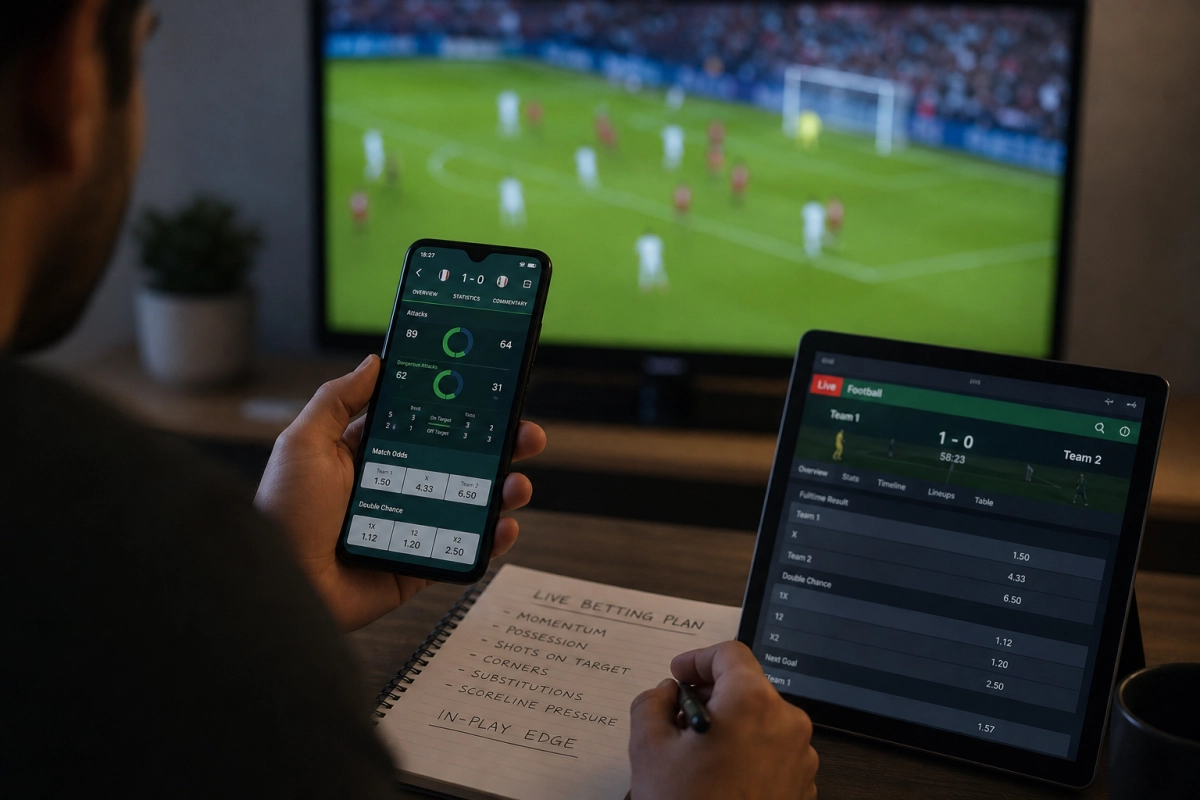
Live football betting: read momentum, understand markets and act in-play
How live football betting markets work and the key in-play options
This section explains what you’ll learn: how live odds form, the main in-play markets to follow and basic terminology so you can translate on-field momentum into informed live choices. The guide emphasises observable match factors over pre-match reputation and stresses responsible staking.
What “live odds” and “in-play markets” mean
Live odds are bookmaker prices that change during a match in response to events (goals, cards, substitutions), betting volume and remaining time. In-play markets are bets placed after kickoff; prices typically move faster as the match progresses because time left is a major factor in probability.
Main in-play markets explained
- Match result (1X2) — the standard market adjusted in real time.
- Next goal — who scores next (or none); sensitive to possession and attacking momentum.
- Total goals (over/under) — whether the match will exceed a goals line; influenced by tempo and dangerous attacks.
- Asian handicap — balances strength differences; useful when one side dominates but the score is close.
- Both teams to score (BTTS) — yes/no on both sides scoring; linked to defensive shape, injuries and set-pieces.
- Half-time/second-half markets — prices for specific halves; reactive to first-half events and tactical shifts.
- Cash out — settlement to close a position early; value depends on current probability and bookmaker risk management.
- Double chance — covers two outcomes (e.g., home win or draw) and reduces variance in-play.
Which match signals matter most for identifying momentum shifts
Successful in-play choices start by watching a short list of actionable signals available via live coverage or reliable stats. Use these to guide decisions rather than reputations or pre-match odds.
- Possession trends — sustained possession in the attacking third increases shot and goal probability; short bursts matter more than isolated possession.
- Shots and shots on target — frequency and quality of attempts are immediate indicators that odds should shorten for the attacking team.
- Dangerous attacks and entries — entries into the penalty area or high-quality chances (xG context) signal real scoring potential.
- Set-pieces — corners and dangerous free-kicks often correlate with goals, especially late in games.
- Substitutions and tactical changes — attacking subs, formation shifts or removing a key defender can change momentum quickly.
- Cards and injuries — red cards or injuries alter probabilities sharply; a numerical advantage typically produces clear market moves.
- Tempo and time remaining — late-game urgency or time-wasting both shape the realistic chance of further goals; time left is critical.
Remember live odds reflect both match events and market stakes. Observing signals and checking market reactions helps decide which in-play market to target. Responsible staking and patience are essential—never chase losses or treat live markets as guaranteed income.
Example decision flows: translate signals into market actions
Three compact decision flows link observable signals to markets and entry/exit routines so you can act quickly and consistently.
-
Flow A — Sustained attacking momentum (early–mid game)
Signals: repeated box entries, 3+ shots (1+ on target) in 10 minutes, opponent pinned back, increasing corners. Market actions: consider Next Goal for the attacker, Over 0.5/1.5 depending on time, or Asian -0.25/-0.5 if dominance is clear. Entry: only if odds haven’t fully tightened — look for a value gap vs. your estimate. Exit: set profit target (30–50%) or a time stop (close if no clear chances within 12–15 minutes). Stake: 1–2% of bankroll. -
Flow B — Numerical advantage or red card
Signals: red card, stretchered-off player, or removal of a key player. Market actions: back the opposition on Asian handicap (-0.5 or -1 depending on time) or Next Goal. If the incident occurs late (75+ minutes), favour smaller, targeted bets because time limits effect. Entry: size the stake higher the earlier the incident occurs (within staking limits). Exit: consider cashing out if you achieve >50% of target profit quickly. Stake: 1.5–3% early; 0.5–1.5% late. -
Flow C — Late-game chasing and time pressure
Signals: trailing team increases tempo, more corners/free-kicks in final 15 minutes, attacking subs, opponent time-wasting. Market actions: Next Goal or Over 0.5/1.5 depending on time; BTTS if both commit. Entry: smaller stakes; enter only if momentum is sustained for several minutes. Exit: predefine a stop-loss (close if momentum stalls for 6–8 minutes) and accept a cashout that secures a reasonable portion of expected profit. Stake: 0.5–1.5% of bankroll.
Responsible staking rules for live betting: simple, enforceable limits
Live markets are fast and emotionally charged. Rigid, simple rules protect your bankroll and keep decisions disciplined. Use this baseline and adapt only after tracking results and adjusting consciously.
- Unit sizing: define a unit as 1% of bankroll. Typical in-play bets should be 0.5–3 units (0.5–3%). Never exceed 5% on a single live event without a written, pre-agreed rule change.
- Exposure cap per match: limit total combined in-play exposure to 3–6% of bankroll for any single match to avoid correlated ruin.
- Daily and weekly drawdown limits: stop betting for the day after a 6–8% loss; stop for the week at 12–15%. Walk away and review—never chase losses in the same session.
- Cash-out policy: accept cash-out to lock 40–60% of maximum potential profit if volatility spikes and you lack an edge to hold. Don’t cash out from frustration when EV remains positive.
- Scaling and hedging: prefer scaling-in (start smaller, add on confirmation) over impulsive large stakes. Hedge only if it preserves a positive expected return after costs.
- Record-keeping and review: log every live bet (signals, market, stake, outcome, emotional state). Review weekly to refine which flows and staking sizes work for you.
These flows and staking rules make live betting methodical rather than impulsive. Below is a compact match example applying them with illustrative numbers—adjust units to your bankroll and risk profile.
Match walkthrough: a compact 90-minute example
- 0–20 minutes: Team A dominates with 4 shots and two box entries. Flow A: place Next Goal on Team A, 1 unit. Only enter if odds still offer value.
- 20–34 minutes: Momentum stalls; close the Next Goal after ~12 minutes without follow-up chances. Accept a small loss (~0.4 units) to preserve discipline.
- 34 minutes: Team B gets a red card. Flow B: back Team A Asian -0.5, 2 units, and a smaller Next Goal stake of 0.5 units.
- 42 minutes: Team A scores. Asian -0.5 converts. Consider cashing out 60% of profit if volatility spikes and you lack edge to hold; leave remainder in play if confident.
- Half-time: Review logs (signals, emotions, stakes). Net position positive; exposure controlled.
- 70–85 minutes: Team B chases and earns set-pieces. Flow C: small Next Goal/Over 0.5 stake, 0.75 units, with a stop-loss if momentum stalls for 6–8 minutes.
- 88 minutes: Team B equalises from a set-piece. Late bet pays off. Final result: modest aggregate profit with disciplined sizing and capped exposure.
This example shows disciplined entries, pre-defined exits and conservative sizing reduce emotional decision-making while allowing you to exploit clear in-play edges.
Putting the approach into practice
Treat live betting like a short, repeatable experiment: watch clearly defined signals, apply the matching decision flow, size stakes to rules, and record every trade. The goal is not to win every bet but to produce a positive edge over time through consistent process, honest record-keeping and continual refinement of what signals and markets you read best. If ever unsure, step back—your best long-term asset is a disciplined bankroll and a clear head.