Why Live Football Betting Odds Never Stay Still
Football matches are defined by moments — a goal against the run of play, a red card that reshapes both teams’ approaches, an injury to a key striker that changes what feels possible. These moments don’t just alter the match itself. They send ripples through every live betting market connected to it, often within seconds.
Live football betting operates on the principle that odds must reflect reality as closely as possible at any given instant. Bookmakers use automated systems to monitor match data in real time, adjusting prices continuously based on what is happening on the pitch. Understanding why those adjustments happen gives bettors a sharper lens through which to assess value — and risk — during a live match.
This article examines the specific match events that cause in-play odds to shift and explains the logic behind those movements. It does not offer guarantees or systems. Betting always carries financial risk, and outcomes can never be predicted with certainty.
The Match Events That Move Markets Most Dramatically
Not every moment in a football match triggers the same market reaction. Some events carry such immediate implications for the result that odds move sharply and swiftly. Others create subtler shifts that only become significant when combined with wider match context.
Goals and How They Rebalance Match Odds
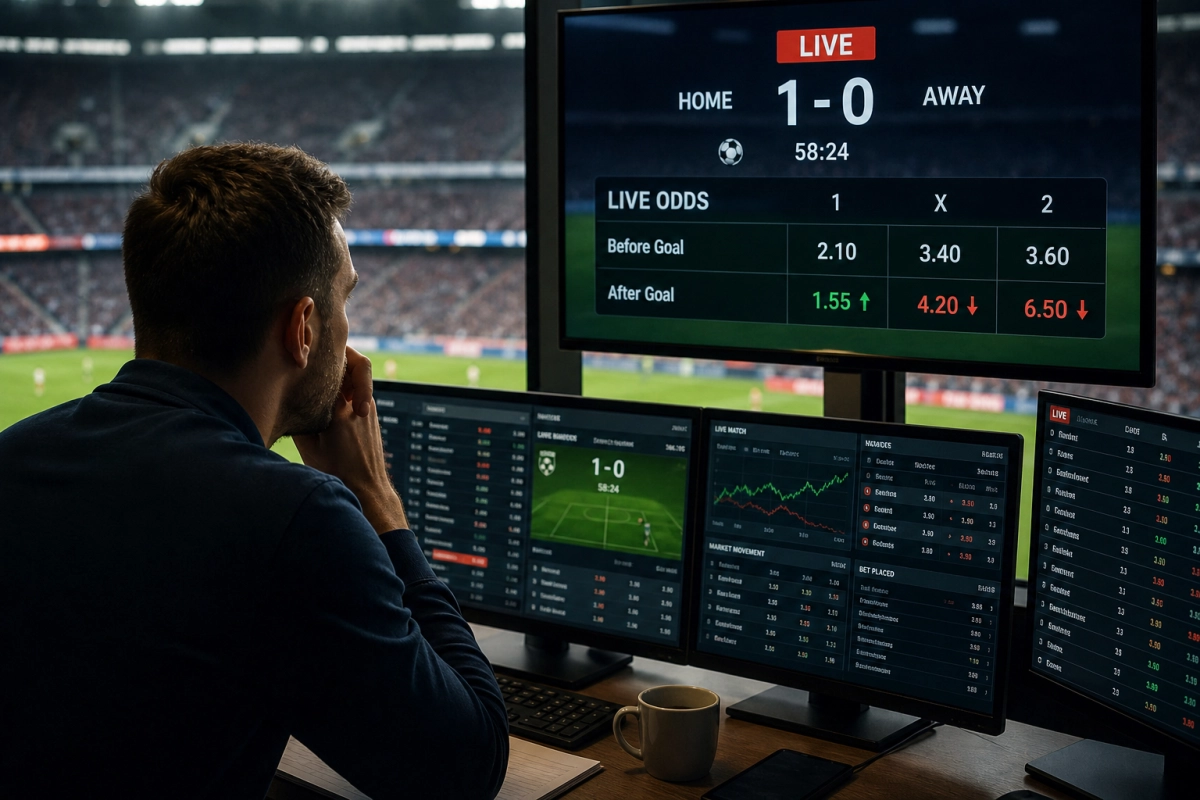
A goal is the single most impactful event in live football betting. The moment a team scores, the match result market resets almost entirely. The scoring team’s odds shorten considerably while the opposition’s lengthen. The size of that shift depends on the current scoreline, the minute the goal arrives and how dominant either team has been.
A goal in the 25th minute of a 0-0 match affects odds differently from one in the 75th minute. Earlier goals leave more time for a response, so the market reacts with some caution. A late goal in a tight match can compress the trailing team’s odds to equalise quite dramatically — partly because time is limited, but also because trailing teams commit more players forward, increasing the likelihood of further goals.
Markets beyond the match result are equally responsive. In total goals markets, a first goal in the 30th minute of a match priced as a low-scoring contest may trigger a significant move on the over 2.5 goals line. Both teams to score markets and next goal markets also reset as soon as the ball hits the net.
Red Cards and the Tactical Distortion They Create
A red card introduces one of the most structurally disruptive events in football. Playing with ten men forces tactical reorganisation and defensive consolidation. The ten-man team’s odds to win lengthen noticeably, while the opposition’s chances of victory shorten.
Context shapes the degree of movement. A red card shown to the team already leading by two goals may not shift match result odds as dramatically as the same card shown during a 0-0 draw. Timing matters too — a dismissal in the first half has greater consequences than one in the final ten minutes, simply because the numerical disadvantage must be managed for longer.
Experienced bettors pay close attention to how teams respond in the minutes immediately following a red card. Watching how both sides adapt before committing to a market position is often more informative than reacting instantly to the card itself.
Penalties, Substitutions and Injuries: The Events Bettors Often Underestimate
While goals and red cards dominate the conversation around live odds movement, three other match events carry significant weight — often more than casual bettors appreciate. Penalties, substitutions and injuries each shift the probability landscape in distinct ways.
Penalties and the Dual Wave of Odds Movement
A penalty creates two separate moments of market disruption. The first occurs when the penalty is awarded. Match result odds move immediately, because a penalty carries a high conversion rate and bookmakers adjust accordingly. In many cases, bookmakers will suspend markets entirely while the kick is being taken, reopening them once the outcome is known.
The second wave follows the penalty’s result. A converted penalty triggers the same rebalancing as any goal, though often more sharply because the market had already partially priced in the probability. A missed penalty — particularly one expected to level the match — can move odds dramatically in the opposite direction. Experienced traders also factor in the psychological dimension: a missed penalty frequently suppresses a team’s attacking momentum, affecting next goal and total goals markets.
Where penalties become particularly interesting is in how they interact with existing market positions. A team trading at generous odds to score next, which then earns a penalty, may offer value in the seconds between the award and the suspension of markets — a window that requires fast thinking and genuine match awareness.
Substitutions as Market Signals Worth Reading Carefully
Substitutions are among the most frequently misread events in live football betting. A well-timed substitution — or a defensive one made under pressure — can meaningfully reframe what the remaining minutes are likely to produce.
A manager bringing on an additional striker in the 65th minute while trailing by one goal is communicating tactical intent clearly. Total goals markets, both teams to score markets and next goal markets should all shift in response. Conversely, a leading team substituting an attacker for a defensive midfielder signals equally clear intentions about how they plan to see out the match.
Bettors who watch matches closely often spot substitutions before bookmakers have fully processed their tactical implications. The live odds adjustment following a substitution tends to lag behind that of a goal — there is more interpretive ambiguity involved — which creates a brief window where the market may not yet reflect the full significance of the change.
Injuries and the Asymmetry of Their Market Impact
The market impact of an injury depends heavily on the player involved, the nature of the injury and whether a substitution is made immediately or delayed while the player attempts to continue.
An injury to a central striker carries different implications from one affecting a full-back. Losing a team’s primary goalscorer shifts total goals lines and both teams to score markets more noticeably than match result odds — particularly if the team has been heavily reliant on that individual for attacking threat. An injury in goal, especially if the replacement appears uncertain, can shift odds in ways that go beyond what the scoreline alone would suggest.
Injuries to key defensive players sometimes generate less immediate market movement than their tactical significance warrants. The disruption caused by reshuffling a defensive unit can take several minutes to manifest in match play, meaning the odds may not fully catch up until the structural weakness becomes visible.
- An injury to an attacking player typically affects goal markets more immediately than match result odds.
- Defensive injuries can create underappreciated vulnerability that takes time to appear in both play and pricing.
- The severity and location of an injury — assessed visually during the match — provides context that raw data feeds cannot always capture in real time.
Reading the Match to Read the Market
Live football betting odds are not arbitrary numbers generated by algorithms disconnected from reality. They are, at any given moment, the market’s best attempt to quantify what is most likely to happen next — updated continuously as goals are scored, cards are shown, players are substituted and injuries reshape the dynamics of play. Every price movement tells a story about how the market is interpreting events, and learning to read that story is one of the most transferable skills a live bettor can develop.
Context transforms each significant moment, and context is precisely what automated pricing systems are slowest to absorb. That lag between event and full market adjustment is where attentive, informed bettors find their most meaningful edge. It is not a guaranteed edge — markets become more efficient over time, and the window between a significant event and its full reflection in prices can be measured in seconds. But for bettors who have prepared properly, who understand the teams involved and who are watching the match rather than just monitoring a price feed, those seconds represent genuinely more informed decision-making.
Not every event warrants a market position. Some shifts in odds are entirely rational and offer no value. Others are overreactions — the market punishing a team more severely than the event warrants — and recognising those moments requires both analytical clarity and emotional detachment. Reacting to live match events with instinct rather than reasoning is one of the most common and costly habits in in-play betting.
- Goals trigger the sharpest odds adjustments, with timing and match context determining the degree of movement.
- Red cards restructure matches tactically, and their full market implications take time to emerge in both play and pricing.
- Penalties generate two distinct waves of market movement: at the point of award and again following the outcome.
- Substitutions carry clear tactical signals that affect multiple markets simultaneously, yet are frequently underweighted by casual bettors.
- Injuries create asymmetric market responses, with defensive disruptions often underpriced relative to their actual impact.
- The gap between a significant event and its full absorption into live prices is where preparation and genuine match understanding create the most value.
Football will always produce moments that defy expectation. The market can be wrong, odds can misrepresent probability, and results can confound even the most carefully reasoned positions. Approaching live betting with that humility — while still applying rigorous thinking to every decision — is what separates informed participation from uninformed speculation. The odds move because the match moves. Understanding why they move the way they do is the starting point for everything else.