Live Football Odds Are a Language — Here Is How to Read Them
Most bettors glance at live football odds and see a number. What they are actually looking at is a constantly shifting reflection of everything happening on the pitch — and everything happening in the market. Understanding the difference between those two forces is where informed decision-making begins.
Live odds do not simply update because a goal is scored or a card is shown. They move in response to match tempo, possession patterns, the volume and direction of bets being placed, and time remaining on the clock. Each fluctuation carries information. Learning to interpret that information — rather than just reacting to it — separates casual in-play bettors from those who approach the markets with genuine structure.
Why Live Odds Move: Match Events Versus Market Pressure
Two distinct forces drive every live odds change. The first is event-driven movement — a red card, a goal, a penalty award, or a serious injury causes odds to shift sharply because the probable outcome has materially changed. These movements tend to be steep and immediate.
The second is market-driven movement. When a large volume of bets flows toward one outcome, bookmakers adjust their odds to manage liability, regardless of what has happened on the pitch. This type of movement is subtler but equally informative. A gradual drift in the draw price during the first half might suggest that sharp money is moving toward one side — even if the match looks level.
Recognising the source of a movement matters. A team’s win odds shortening rapidly just before a goal is scored is not prediction — it is the market reacting to dangerous play, shots on target, or a momentum shift that data is already capturing. By the time the goal goes in, the odds have often already moved significantly.
How Remaining Time Shapes Every Price
Time is a constant, invisible variable in live odds. As minutes pass, the range of possible outcomes narrows, and bookmakers price that certainty into every market. A team leading 1–0 in the 80th minute is priced very differently from one leading by the same margin at half-time — not because the scoreline has changed, but because the opportunity for the match to change has shrunk.
This time compression affects all markets. A bet on over 2.5 goals at 0–0 in the 30th minute carries very different value from the same bet at 0–0 in the 65th minute. The remaining time has fundamentally altered the probability, and the odds reflect that precisely. Assuming an unchanged scoreline means unchanged value is one of the most common traps in live betting.
Reading the Signals: What Rapid Movements Actually Mean
When live odds move sharply without an obvious on-pitch trigger, rapid and consistent movement across multiple bookmakers simultaneously tends to indicate that informed money has entered the market with conviction. Sharp bettors, syndicates, and algorithmic traders operate with data feeds capturing match events in near real time — expected goals, pressing intensity, shot trajectories. When their models identify a mispriced outcome, they act quickly and at volume. The odds respond.
Several patterns are worth learning to recognise:
- Rapid shortening on one team without a goal: Often signals sustained pressure, corners, shots on target, or an unconfirmed injury to a key opposition player. The market is pricing a shift in match dynamics before the scoreboard reflects it.
- A drifting favourite after taking the lead: Can indicate the market believes the winning team is sitting deep and inviting pressure, increasing the probability of a comeback.
- Sudden suspension of a market: Bookmakers pull prices when they lack confidence in their model — typically around VAR checks, confirmed injuries, or imminent substitutions. A suspended market is itself a signal that something significant is developing.
- Odds moving against obvious public sentiment: If a crowd favourite drifts despite apparent control, sharper participants likely see something the casual eye does not — fatigue, tactical vulnerability, or statistical regression beneath the surface.
None of these signals should be read in isolation. A consistent pattern across multiple markets — match result, next goal, and Asian handicap all moving in the same direction simultaneously — carries considerably more weight than any single price shift.
Using Odds as a Decision-Making Tool, Not a Price Guide
The most important conceptual shift is this: a price is passive — it tells you what something costs. A decision-making tool is active — it tells you whether a scenario has been accurately assessed, and where your judgment might diverge from consensus.
This starts before kick-off. Entering a live betting situation with a pre-formed view of how a match is likely to develop — based on form, tactical setups, and injury news — gives you a reference point against which to measure live odds as they evolve. Without that baseline, you are reacting to prices rather than comparing them against an independent assessment.
Consider a match where you expect a high-scoring game based on both teams’ defensive vulnerabilities. If the first twenty minutes produce cautious play and a 0–0 scoreline, the over 2.5 goals market may drift outward as the market updates to what it sees rather than what the underlying conditions suggest. That drift — if your pre-match reasoning remains valid — could represent genuine value, not because the price has moved but because your assessment diverges meaningfully from the current consensus.
This requires discipline. A goal scored against the run of play can compress odds on the scoring team dramatically, even when match dynamics still favour their opponents. Recognising that asymmetry and acting on it calmly is where structured live betting finds its clearest edge.
Cross-Referencing Multiple Markets
Experienced in-play bettors rarely focus on a single market. They read several simultaneously, using relationships between prices as an additional information layer. The Asian handicap, match result, and over/under goals markets each price the same match from a different angle — when they move in contradictory directions, the inconsistency itself becomes a signal worth investigating.
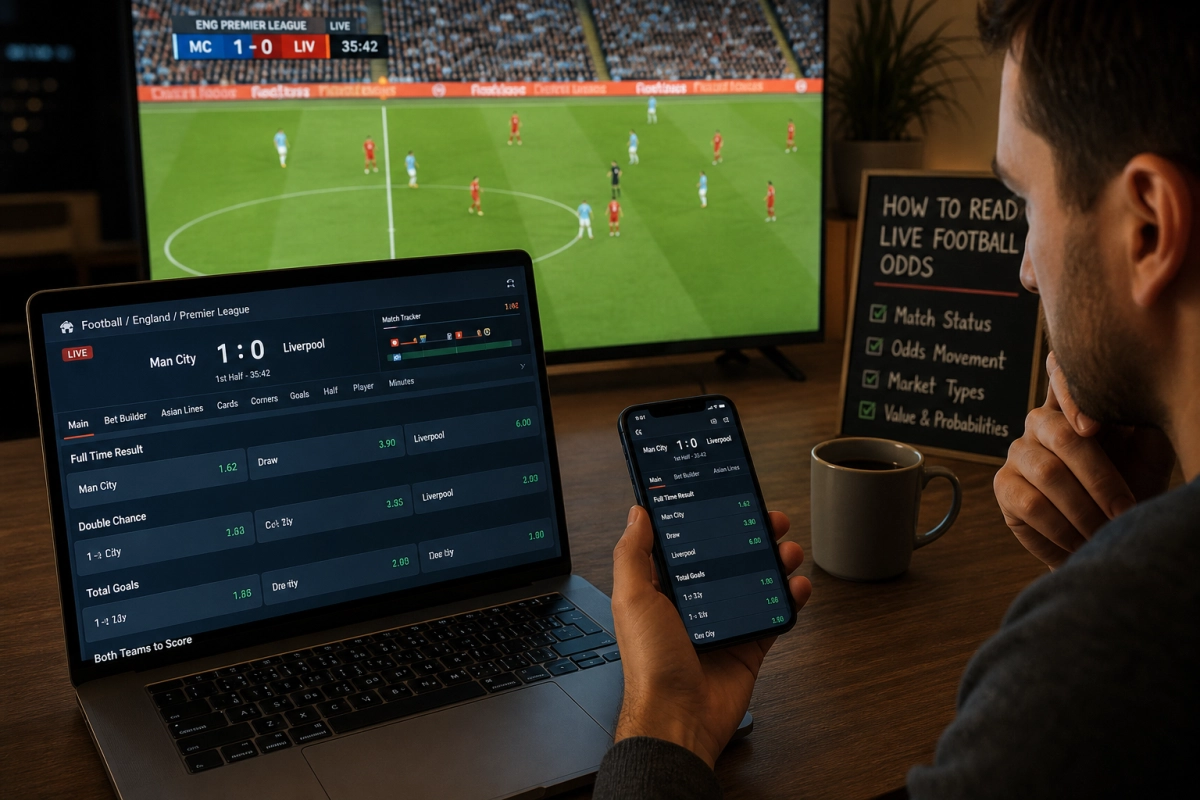
If the match result market shortens heavily on the home side but the Asian handicap line barely moves, the market may be pricing a likely home goal without believing the team will dominate beyond it. If the handicap shifts aggressively while the result price barely moves, volume may be entering around a close victory rather than a commanding win. This cross-referencing discipline takes practice, but the most useful information often lives in the spaces between markets rather than in any single number viewed alone.
Staying Disciplined When the Market Moves Fast
Live odds move faster than most bettors can comfortably process, and that speed is part of the challenge. The pressure to act before a price disappears is real, but it is also one of the most reliable ways to make poor decisions. Reacting to urgency without a clear framework is not decisiveness — it is impulse dressed up as timing.
The antidote is preparation. Knowing in advance which markets to watch, what movements would confirm or contradict your pre-match view, and what price range represents a meaningful divergence from your own assessment removes the need to think from scratch under pressure. When a signal appears that matches your criteria, you act. When it does not, you observe and wait.
It is also worth acknowledging that not every match will offer a moment worth acting on. A market that moves entirely in line with visible on-pitch events and reflects broad public sentiment is simply efficient. The value in live betting tends to emerge from the gaps: the delayed reaction, the overcorrection, the moment where emotional market sentiment and underlying match data briefly point in opposite directions. Those moments are not constant, and waiting for them patiently is part of the discipline itself.
Odds as a Mirror — and a Map
Live football odds serve two functions simultaneously. They mirror what the market collectively believes is happening at any given moment, and they map the probable territory of outcomes still ahead. Reading them well means holding both functions in mind at once — understanding what the current price reflects about present conditions while asking whether that reflection is accurate, proportionate, and consistent with your own assessment.
The bettors who use live odds most effectively are not necessarily those with the fastest reactions or the most sophisticated data tools. They are the ones who have taken the time to understand what the numbers are actually communicating — not just the price, but the pressure behind it, the speed of the movement, the consistency across related markets, and the story that emerges when all of those signals are read together.
Approaching live odds as a language rather than a lottery is a shift that takes time to embed. But once the habit of reading rather than simply reacting is established, the market stops feeling like noise and starts functioning as one of the most detailed, continuously updated sources of match intelligence available — one that rewards those who have learned how to listen to it properly.