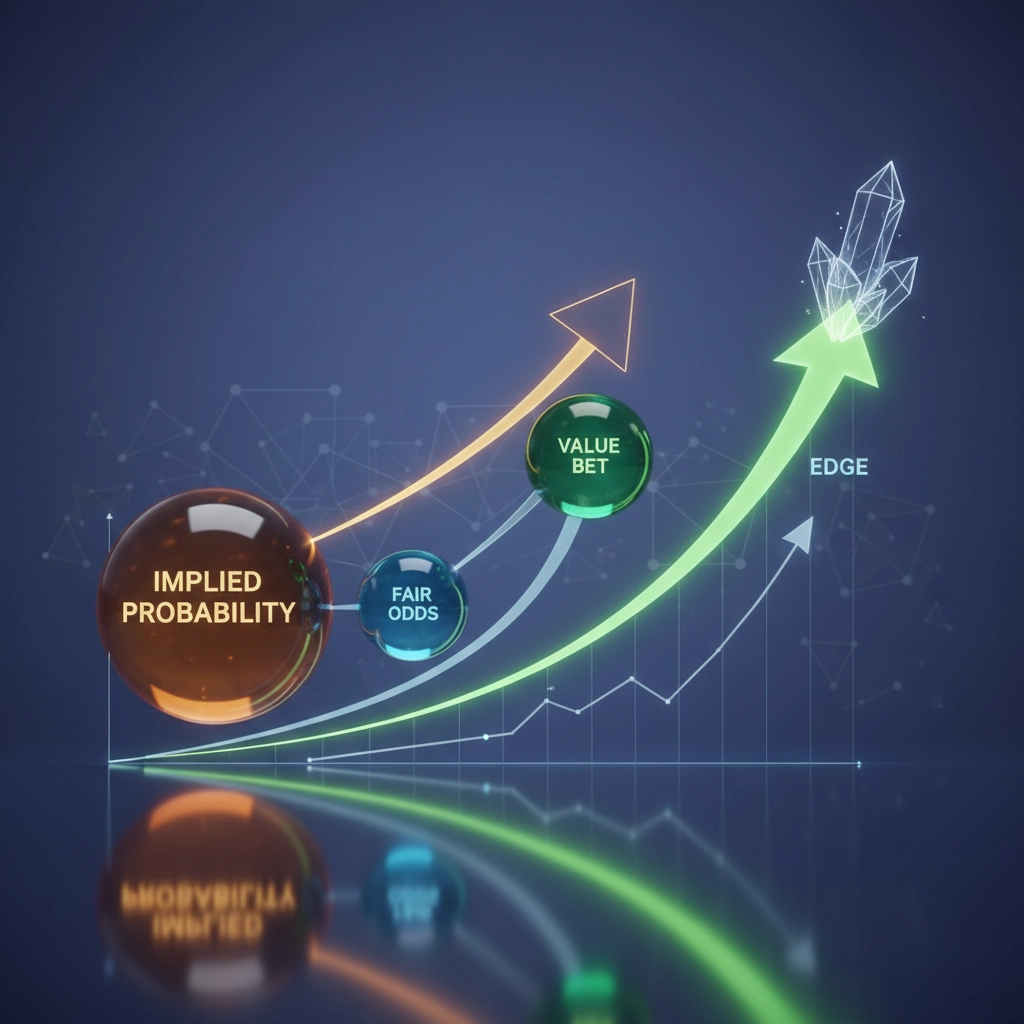
Why favorites feel safe — and why that can cost you
You naturally trust favorites. They win more often on paper, get more headlines, and make you feel like risk is minimized. But in sports betting, “winning more often” isn’t the same as “making you money.” You need to judge each wager not by the label “favorite” but by whether the price you can get offers positive expected value over time.
Bookmakers build odds to balance liability and protect profit, not to mirror true probabilities. That means favorites often carry embedded costs: lower payouts and heavier market adjustment (vig). When you chase favorites without checking the price against an independent estimate of the true probability, you’re accepting a lot of implicit bookmaker profit.
How the market and psychology push you toward favorites
Several forces make favorites attractive, and they can mask long-term weakness in your betting approach:
- Recency and availability bias: You remember high-profile wins and assume the favorite will repeat them.
- Lower volatility feel: A favorite’s smaller odds feel “safer,” so you may bet bigger stakes on them without accounting for poor value.
- Public money: Heavy public backing inflates favorite prices early, then sharp money may move lines later — you often get worse odds by betting late on favorites.
- Vigorish (vig): The bookmaker’s margin hits short-priced favorites proportionally harder than longer shots — meaning you need a higher true win rate to break even.
What “value” really means and why it beats favorites long-term
Value is simple: a bet has value when your estimate of the true probability of an outcome is higher than the implied probability from the odds. You win over the long run by exploiting consistent gaps between your model or insight and the market’s pricing — not by backing the team that most people expect to win.
Basic math of value you can use today
You don’t need a PhD to apply value thinking. Convert odds into implied probability, subtract the bookmaker’s margin, and compare to your own probability estimate. For example, if decimal odds are 2.50, the implied probability is 40% (1 / 2.50). If your independent analysis puts that event at 48%, you’ve identified value.
Two practical habits separate value bettors from favorite-chasers:
- Quantify your edge: Maintain simple models or checklists so your probability estimates are consistent and defensible.
- Staking discipline: Use unit sizing and a fixed staking plan so one bet doesn’t derail your bankroll when variance hits.
In short, favors feel familiar but rarely guarantee profitability; value is the currency that compounds. In the next section, you’ll learn step-by-step methods to calculate implied probability, remove vig, and set a staking strategy that turns small edges into consistent profits.

Step-by-step: calculate implied probability and strip out the vig
Start with the concrete steps you can apply to any market. Doing the math consistently removes guesswork and exposes whether a favorite—or any price—is actually worth backing.
- Convert odds to implied probability: For decimal odds, implied probability = 1 / decimal odds. Example: 2.50 → 1 / 2.50 = 0.40 or 40%.
- Measure the market overround (vig): Sum the implied probabilities for all outcomes. In a two-way match with odds 1.60 and 2.30: 1/1.60 = 62.50% and 1/2.30 = 43.48%. Sum = 105.98% — that 5.98% is the book’s margin.
- Remove the vig (normalize probabilities): Divide each implied probability by the sum to get fair probabilities. For the favorite: 62.50% / 105.98% = 59.0% fair probability. For the underdog: 43.48% / 105.98% = 41.0% fair probability. Convert back to fair odds if you prefer: fair decimal odds = 1 / fair probability (favorite ≈ 1.69).
- Compare to your estimate: If your independent estimate for the favorite is higher than 59.0%, there is value; if it’s lower, it’s negative EV even though the team is the favorite.
Applying the same steps to multi-outcome markets (totals, props) is identical: convert, sum, normalize, compare. Always use the normalized (vig-free) probabilities when checking for value — otherwise you’re chasing false positives created by the book’s margin.
Practical staking strategies that turn small edges into consistent profits
Finding value is half the job; staking correctly is the other half. Here are simple, proven approaches you can implement immediately.
- The Kelly framework (and why to use a fraction of it): Full Kelly maximizes long-term growth but can be volatile. Formula for decimal odds: f = (bp – q) / b, where b = odds – 1, p = your probability, q = 1 – p. Example: odds 2.50 (b = 1.5), your p = 0.48 → f = (1.50.48 – 0.52) / 1.5 = 0.1333 (13.3% of bankroll). Most pros use fractional Kelly (1/4 or 1/2 Kelly) to reduce variance: quarter-Kelly here ≈ 3.3%.
- Flat-unit system: Pick a unit equal to a small percentage of your bankroll (1–2% is common). Bet more units only when your model shows a larger edge. Flat units are simple, curb emotional over-betting, and make tracking ROI straightforward.
- Edge-weighted scaling: Scale stakes proportional to your assessed edge but cap extremes. For example, 1% unit for edges under 5%, 2–3% for edges 5–10%, and cap at 5% for exceptionally rare high-confidence spots.
Whichever method you choose, apply it consistently. Use line shopping to get the best price before staking — getting 2.50 instead of 2.40 can turn a marginal bet into a clear value over time.

Simple tools and checks to make value betting repeatable
Repeatability beats one-off “swoop” wins. Build a small toolkit:
- EV calculator: For a unit stake, expected value = p odds – 1. Example: p = 0.48, odds = 2.50 → EV = 0.482.5 – 1 = +0.20 (20% return per unit on average).
- Record keeping: Track date, market, odds, stake (units), your estimated probability, and outcome. Calculate ROI and move averages monthly.
- Sample-size awareness: Even strong edges require many bets to show up statistically. Don’t judge a model by 20 bets; judge it by hundreds.
- Bias checklist: Before placing a wager, run a quick checklist: Did I shop lines? Is my model recent-data driven? Am I emotionally tilted by news or recency?
Small edges, correctly sized and repeated over time, compound. Favorites can feel safer, but the math above shows why disciplined value betting — not instinctive favorite-chasing — wins in the long run.
Putting value into practice
Stick to the process: cultivate independent probability estimates, shop lines, size stakes to your assessed edge, and treat short-term results as noise. Value betting isn’t about chasing the comfortable — it’s about consistently looking for small, measurable advantages and letting disciplined bankroll management turn them into long-term gains. For a concise overview of staking math that many bettors use as a starting point, see Kelly criterion primer.
Keep learning, keep records, and prioritize repeatability over highlight reels. Over time, the combination of accurate probability assessment and disciplined sizing is what separates profitable bettors from favorite-chasers.
Frequently Asked Questions
How can I tell if a favorite is actually good value?
Convert the market odds to implied probabilities, normalize them to remove the vig (bookmaker margin), and compare the resulting fair probability to your independent estimate. If your estimate is higher, the favorite is value; if lower, it’s negative EV despite being the favorite.
How much of my bankroll should I bet on a value pick?
Use a disciplined staking plan: many bettors use fractional Kelly (e.g., 1/4 or 1/2 Kelly) to reduce volatility, or a flat-unit system of 1–2% of bankroll per standard unit. Scale up modestly for larger assessed edges but cap stakes to protect against variance.
How long should I run a value strategy before judging its effectiveness?
Expect to need hundreds of bets for meaningful statistical evidence. Track ROI, moving averages, and confidence intervals monthly, and avoid changing models based on short runs. Patience and consistent record-keeping are essential to separate skill from variance.