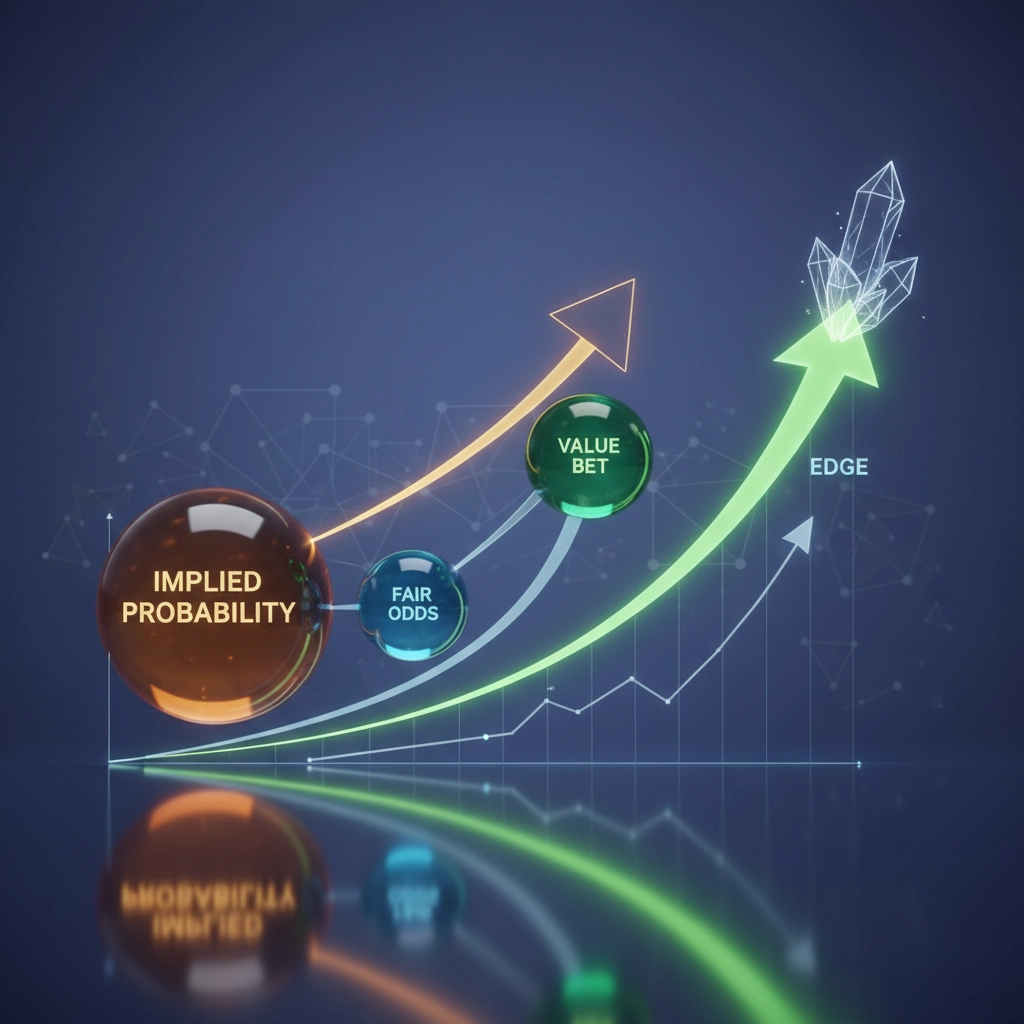
Why understanding implied probability will change how you place bets
You probably already look at odds and pick winners. Value betting asks you to go a step further: you estimate the true probability of an outcome, compare that to the bookmaker’s implied probability, and only stake when you have a positive edge. That shift—from choosing likely winners to choosing bets with positive expected value—is what separates casual bettors from long-term winners.
In practical terms, value betting means you don’t chase “sure things”; you systematically look for mismatches between your assessment and the market. To do that you must be fluent in converting odds formats into implied probability and in translating probability differences into an expected value or edge.
How to convert common odds formats into implied probability
Bookmakers display odds in three main formats: decimal, fractional, and American. You’ll need simple formulas to turn each format into implied probability so you can compare it to your own estimate.
- Decimal odds — implied probability = 1 / decimal odds. Example: 2.50 → 1 / 2.50 = 0.40 (40%).
- Fractional odds (a/b) — implied probability = b / (a + b). Example: 3/2 → 2 / (3 + 2) = 0.40 (40%).
- American odds — for positive odds (+X): decimal = (X / 100) + 1, then implied = 1 / decimal. For negative odds (-Y): decimal = (100 / Y) + 1, then implied = 1 / decimal. Example: +150 → decimal 2.50 → 40% ; -150 → decimal 1.67 → 60%.
Remember: implied probabilities from bookmaker odds usually sum to more than 100% across all outcomes because of the bookmaker margin (vig or overround). That margin inflates the implied probabilities and must be considered when assessing value.
From implied probability to edge and expected value
Once you have the implied probability, compare it to your assessed (true) probability. Two common ways to express an advantage are “edge” and “expected value (EV)”.
- Implied probability = what the market believes; computed from the odds as shown above.
- Edge (simplified) = your probability − implied probability (expressed in percentage points). A positive number suggests potential value.
- Expected value (per unit stake) = (YourProb × DecimalOdds) − 1. If this number is greater than 0, the bet has positive EV.
Example: decimal odds 1.91 imply ~52.36%. If you assess the chance as 55%, then edge ≈ 2.64 percentage points and EV per unit = (0.55 × 1.91) − 1 ≈ +0.0505 (about +5.05% expected return per unit stake).
Before you act on a perceived edge, adjust for the bookmaker’s vig (normalize implied probabilities) and consider the magnitude of the edge — small edges can be washed out by odds movement, limits, or model error. Next, you’ll see step-by-step worked examples of these calculations and how to remove the vig so you can identify true value opportunities.

Worked examples: removing the vig and calculating true edge
The simplest and most practical way to spot value is to normalize the bookmaker-implied probabilities (remove the vig) and then compare those to your own probabilities. Here’s a step‑by‑step worked example for common markets.
Two-way market (tennis, head‑to‑head)
– Odds: Player A 1.80, Player B 2.10.
– Implied: A = 1/1.80 = 0.5556 (55.56%), B = 1/2.10 = 0.4762 (47.62%). Sum = 1.0317 (103.17%).
– Remove vig (normalize): A_true = 0.5556 / 1.0317 = 0.5387 (53.87%); B_true = 0.4762 / 1.0317 = 0.4613 (46.13%).
– If your model says A has 56% chance, your edge = 56% − 53.87% = +2.13 percentage points.
– EV per unit stake = (YourProb × DecimalOdds) − 1 = (0.56 × 1.80) − 1 = +0.008 (≈ +0.8% expected return).
Three-way market (soccer: home/draw/away)
– Odds: Home 2.60, Draw 3.20, Away 2.80.
– Implied: Home = 0.3846, Draw = 0.3125, Away = 0.3571. Sum = 1.0542 (105.42%).
– Normalize: Home_true = 0.3846/1.0542 = 0.3649 (36.49%); Draw_true = 0.2967 (29.67%); Away_true = 0.3384 (33.84%).
– If you estimate Home at 40%, edge = 40% − 36.49% = +3.51pp. EV = (0.40 × 2.60) − 1 = +0.04 (+4% per unit).
Notes on these calculations
– Always use normalized implied probabilities when you want the bookmaker’s “fair” market view after removing vig. For EV, use your assessed probability and the decimal odds as shown.
– Small percentage‑point edges often translate into small EV per stake; that’s normal. The goal is a portfolio of positive‑EV bets, not a single large winner.
– Watch for market movements: if odds shorten after you place a bet, your realized EV falls. Line shopping across multiple books is essential to capture the best odds before they move.
Turning edges into profit: staking, Kelly sizing, and practical limits
Finding value is only half the job — you must stake correctly to convert small edges into long‑term profit while surviving variance.
Kelly gives a mathematically optimal fraction: f = (b·p − q) / b, where b = decimal odds − 1, p = your assessed probability, q = 1 − p. Example: for A at 1.80 (b = 0.8) with p = 0.56, f = (0.8×0.56 − 0.44)/0.8 ≈ 0.01 → 1% of bankroll. That small fraction reflects the modest edge and low odds. Full Kelly is volatile and sensitive to model error, so most professionals use fractional Kelly (e.g., 10–50%) to reduce drawdowns.
Practical staking rules
– Use a fixed percentage or fractional Kelly based on your confidence and edge consistency.
– Limit stake size relative to the market: large stakes can move lines or trigger limits. If a required stake is large compared to market liquidity, the edge is likely illusory.
– Shop lines across bookmakers and use exchanges where possible to capture the best prices and avoid premature limits.
– Track closing‑line value (CLV): beating the closing market consistently is the strongest indicator your model has real edge, even if short‑term variance masks profit.
Managing variance and expectations
– Even with positive EV, expect losing streaks. Calculate worst‑case drawdowns for your staking plan and ensure your bankroll can withstand them.
– Small recurring edges require volume and discipline. Maintain meticulous records, refine your model, and be conservative with Kelly fractions until you’ve proven stability.
– Finally, remember execution costs (commission, withdrawal fees, bet delays). These can turn marginal edges negative, so always factor them into your staking decisions.

Putting value betting into practice
Finding edges and staking them sensibly is part science, part discipline. Focus on testing your probability model, tracking results, and protecting your bankroll with conservative sizing. Expect variance, be ready to refine your approach, and prioritize execution — line shopping, quick placement, and accounting for commissions all matter. If you want a deeper refresher on the math behind these decisions, see expected value.
Frequently Asked Questions
How can I test whether my probability estimates are accurate?
Backtest your model on historical data and track live results. Use calibration measures (e.g., calibration plots, Brier score) and monitor closing‑line value — consistently beating the closing market is strong evidence your estimates have predictive value. Ensure you have sufficient sample size before drawing firm conclusions.
What minimum edge is worth betting on?
There’s no universal cutoff; it depends on transaction costs, staking method, and market liquidity. Small edges (1–3pp) can be valuable if you can apply them at scale and capture the best available odds, but they’re vulnerable to fees and limits. Use fractional Kelly and require a margin for model error when deciding which edges to stake.
How does the bookmaker’s vig affect my evaluation of value?
The vig inflates implied probabilities so the raw odds aren’t “fair.” Normalize the market probabilities (remove the overround) to compare with your assessed probabilities. Even after normalization, remember bookmakers adjust prices for liability and smart money, so factor in line movement and practical limits when claiming value.